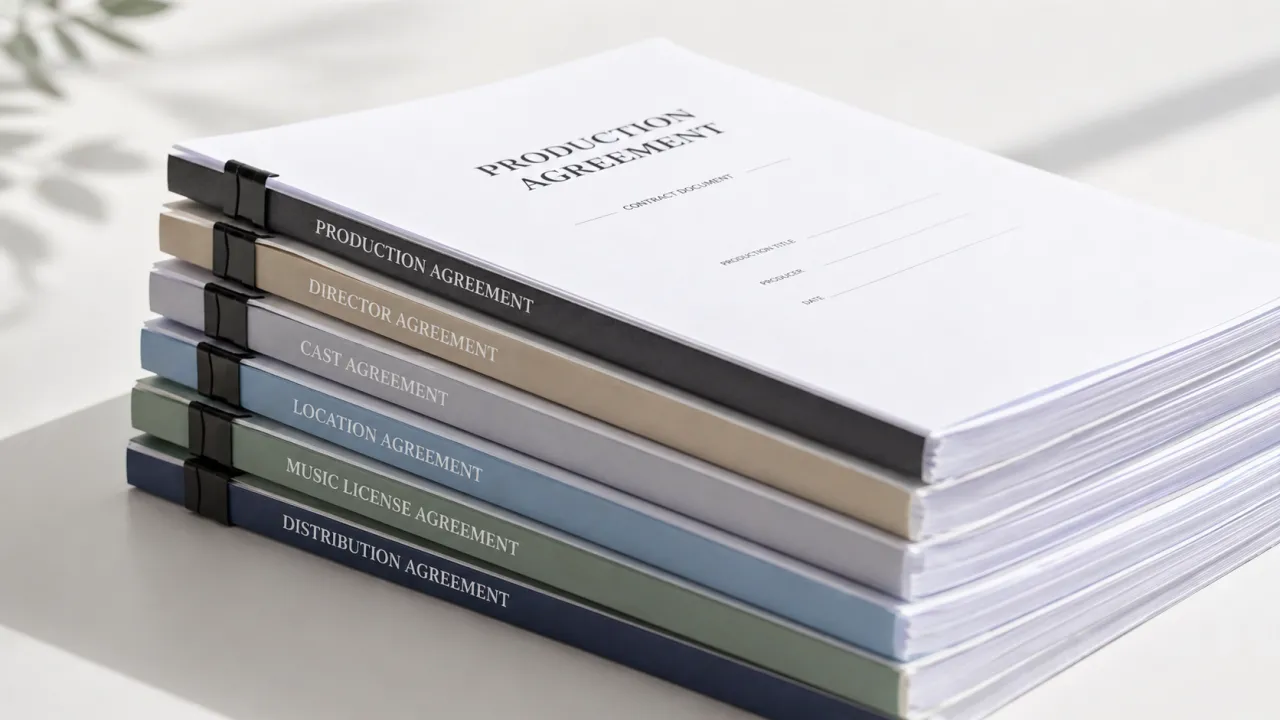
Film contracts and agreements protect the rights of your film and are necessary to avoid miscommunication and risk at every stage from pre-production to distribution.
Agreements need to be set in place with your production team, cast and crew even from before principal photography begins.
Film Production Contracts
Pre-Production Contracts
Pre-production refers to the period of a film before production and shooting begins when those in charge of getting the film up and running finalize the rights and the script, get financing in place, put together the cast and crew and prepare for production.
The early stages of pre-production are often called “development”.
The development stage can last for many years, as rights are acquired and cast and crew are slowly assembled.
Agreements that are commonly needed during this period are those for the purchase of rights, the development of the script, and the hiring of writers to finalize the script.
Rights purchase agreements, option agreements, writer “work for hire” or collaboration agreements and co-production agreements are among the many types of contracts necessary to engage talented individuals to develop a script for production.
The Production Entity – Company
In order to finance a feature film, producers generally form a production company and sell interests in the business entity.
A production company can be any form of business entity, such as a corporation, a limited partnership (“LP”) or a limited liability company (“LLC”).
Generally LLCs are recommended as production entities. They are the most flexible in terms of tax treatment and allocation of power among and between members while still providing the benefits of limited liability for the business owners.
This means that personal assets of individual LLC members will be protected from the debts of the LLC.
To form an LLC, organizational papers must be filed with the secretary of state in the state of formation, along with filing fees.
In some states, such as New York, there is also a publication requirement.
Members of LLCs can be individuals or other entities, such as corporations or other LLCs.
The basic agreement necessary for an LLC is called an operating agreement, which sets forth the rules that govern the LLC and is analogous to a “shareholders’ agreement” for a corporation.
The operating agreement must address keys issues such as management control, the scope of the business of the LLC, the personal role of the filmmakers and their fees, as well as the role and obligations of investors and the priority and allocation of return of their investment.
Also, while many people do not like to discuss the dissolution of a business at the time of formation, the operating agreement should nevertheless address what would in the event that the LLC needs to be wound up or if new members need to be added because of death, disability or budget shortfalls.
From the filmmakers’ perspective, it is very important that the operating agreement be drafted to ensure that the filmmaker retains complete control of the company’s management.
As films are highly personal to the filmmaker, the operating agreement should include a “contingency plan”, which as the name implies, should lay out the back up plan and consequences in the event that the filmmaker, for whatever reason, cannot complete the project.
We also recommend that the filmmakers’ obligations be more specifically set forth in separate employment agreements, so that the filmmakers become employees of the LLC and the intellectual property created is owned by the LLC under traditional “work for hire” principles.
The investor, on the other hand, will try to negotiate so as to protect his investment and allow for continuity in the event that new creative teams or members need to be brought in for the benefit of the project.
Counsel for the filmmakers would try to draft the agreement to ensure that their clients maintain creative control at least through the initial production and distribution stages.
The operating agreement should further include the investor’s obligations, such as when and how their money will become available to the filmmakers.
Typically, these agreements require that the investor’s funds be released to the filmmaker when there is enough money to make “meaningful progress,” in a manner this is defined by the operating agreement.
Remember, the best way to prevent misunderstandings is to have the expectations of all parties expressly provided for and written down along with contingency plans.
Screenwriter Agreements
Rights Purchase Agreement
A rights purchase agreement is used when a producer desires to purchase a script or story outright from a writer or other owner.
Generally, these agreements are known as "Assignments of Rights" and often include the sale of “the sole and exclusive motion picture, television, photograph record, merchandising and commercial rights and all allied and ancillary rights, throughout the universe, in perpetuity.”
Put simply, a rights purchase agreement provides for the purchase of all rights associated with a motion picture, not just the rights to purchase the script.
Option Agreement
An option agreement is a contractual agreement in which a producer buys the right to purchase a screenplay from a writer or other owner.
Unlike the Rights Purchase Agreement, which is a flat out purchase of a property, an option agreement is not actually the purchase of the right to use the screenplay.
Instead, the producer purchases the “exclusive right to purchase” the screenplay at a later date, for instance, when the producer secures financing.
Writer Agreement
A writer’s agreement is used when a producer engages a writer to adapt or rewrite a screenplay.
Producers should use caution when engaging writers belonging to the Writer’s Guild of America, as additional protections apply.
Crew Contracts
Crew – Above the Line
Above the line crew members are those who control the aesthetics of a movie, such as the director, producer and cinematographer.
These agreements often include compensation, credits, creative control, and profit participation.
Crew – Below the Line
Below the line crew refers to those crew members who deal with hands-on aspects of filmmaking, such as lighting and sound technicians.
Deal memos are often used, which are short agreements outlining compensation, responsibilities and credits.
Cast Agreements
Agreements vary depending on whether actors are SAG or non-SAG, minors, or extras.
SAG agreements include strict requirements on compensation, working conditions, and benefits.
Non-SAG agreements are usually simpler and often use deal memos.
Location Agreements
Location agreements cover the use of filming locations, including duration, fees, liability and usage rights.
Post Production
Postproduction refers to editing, sound design and music composition.
Agreements typically include editor and composer contracts and ownership of the final product.
Producing an independent feature film is not an easy task and often involves a lot of negotiation and agreements in all stages of production.
This article is designed to briefly cover the types and variety of agreements that are most commonly used.
However, each film has its own requirements and it may be necessary to hire an attorney who specializes in filmmaking.